
Why Your Law Firm Needs an Architecture, Not a Product
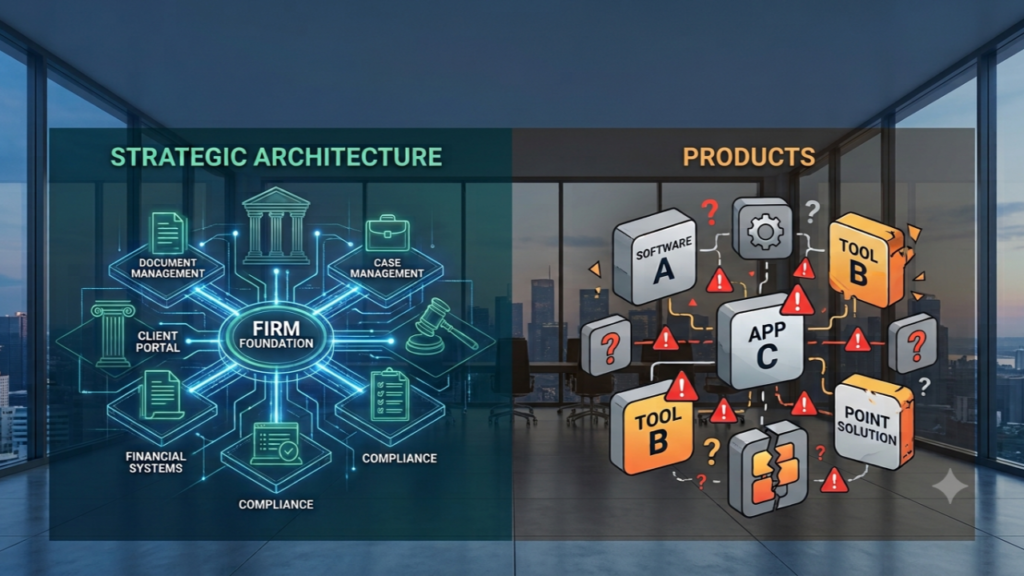
Walk into any legal tech conference and you’ll see the same scene. Booth after booth promising AI that drafts contracts, summarises cases, and transforms your practice. The demonstrations are impressive. The pricing decks are polished. And yet, most managing partners I speak with leave more confused than when they arrived. Not because they don’t understand AI, but because nobody is answering the question they actually have: where do I start, and how do all these pieces fit together?
The confusion is understandable. The legal tech market is fragmented, the marketing is loud, and most law firms don’t have a technology team to cut through the noise. But the reason you can’t decide isn’t a lack of options. It’s that you’re being asked to buy individual products when what you need is a plan for how they work together.
Where You Are: The AI Maturity Model
A useful starting point is understanding where your firm sits today. Helen Fan developed an industry AI maturity model for law firms (published at helenlab.com/valuestack), and it’s quickly become a reference tool across the industry. At a high level the model outlines five stages:
– Level 1 — Raw AI Capability: Individual lawyers use tools like ChatGPT or Claude for research and drafting. Useful, but every session is isolated. Nothing carries over.
– Level 2 — AI + Workflow: The firm has begun standardising outputs and building basic playbooks. Some routine tasks are automated. AI is a helpful assistant, not a system.
– Level 3 — Proprietary Data: AI begins compounding on the firm’s own knowledge — past matters, internal precedents, client history. It gets measurably better with every case.
– Level 4 — AI as Infrastructure: AI becomes the operating layer of the practice. Legal activities are coordinated through it, not alongside it.
– Level 5 — Hybrid Model: AI handles the bulk of execution. Lawyers focus on judgement, strategy, and client relationships.
Most small and medium firms are at Level 1, with a few pushing into Level 2. The vendors at those conferences are selling Level 4 visions. The gap between where you are and where they’re promising to take you isn’t something you close with a credit card. You close it with considered design.
The Architecture: Brain, Body, and Hands
This is where the Duplar model helps. A modern law firm’s technology ecosystem breaks down into three layers:
The Body is your system of record for matters, documents, clients, and pipeline. It knows what stage each case is at, who the opposing party is, and what deadlines are looming.
The Hands are your automation engine. They run in the background: client intake workflows, invoice chasing, and calendar management. They execute the tasks that don’t require legal judgement.
The Brain is AI — connected directly to both. Instead of navigating complex menus across four different applications, you simply ask: “Which clients are more than a month overdue on their invoices?” or “Create a draft image rights contract for client ABC.” The Brain reads from the Body, instructs the Hands, and returns the result.
The point is that these are three fundamentally different functions. Your matter management system tracks cases, your document system stores files. And your AI can’t deliver real value if it can’t reach into both of them simultaneously. If they’re not connected, your team is still doing the work the AI was supposed to eliminate — you’ve simply added another tool your team has to manage alongside the others.
No single product does all three well. The ones that claim to, do what it says on the tin — one thing well, the rest not so much. That’s not a flaw but rather the reality of specialised tools serving specific purposes. Your job is to wire these layers together so information flows between them.
Data: The Bedrock You Own
Before any of this works, there’s a more fundamental question. Data is the bedrock on which any automation strategy is built. Timesheet data, billing rate data, client data, matter data, case documents, calendar and email data — what is it, where is it held, who owns it, and how is it maintained? If the data is bad, any automation built on it will be bad.
But beyond data quality, there’s an ownership question that most firms haven’t considered. Your firm’s institutional knowledge such as how you run a file, which precedents are current, what a complete matter looks like at each stage, how you’ve handled similar matters before, is your competitive advantage. It’s the reason clients choose you over another firm.
Every legal AI platform wants that knowledge inside their product. They’ll offer to analyse your past matters, learn your patterns, and embed your workflows into their system. That’s convenient. But it’s also a trap. If your firm’s know-how lives inside a vendor’s platform, it stays there when you leave.
The principle: keep your proprietary knowledge separate from your toolset. Your playbooks, checklists, and procedural instructions should live in plain files on infrastructure you control — not embedded in a proprietary platform. If a better model arrives next year, or your vendor doubles their pricing, your institutional wisdom moves with you. That’s not paranoia. It’s sovereignty over your own competitive advantage.
The Problem Nobody Talks About: Knowledge Rot
Every law firm has tried to document its procedures. Detailed wikis. Thick procedure manuals. And they all share the same fate — they drift out of date. Regulations shift. Court systems change their portals. Partners refine their approach. Keeping documentation current is non-billable work that always loses to billable work. When the person who maintained it leaves, the knowledge base quietly dies.
This is where AI shifts from tool to infrastructure. Instead of relying on someone to manually keep procedures updated, create an AI agent to monitor what’s happening across your matters and flag where your documentation no longer matches reality. It drafts a revision to the relevant playbook and routes it to a partner for approval. Nothing changes without a human sign-off. But the maintenance burden (the thing that has sunk every documentation initiative your firm has ever attempted) is no longer a manual chore.
A tool drafts a document. Infrastructure compounds. The system gets smarter every time your firm handles a matter.
Where to Start: Three Steps This Week
You don’t need to overhaul your firm. You need to lay foundations.
1. Map your data. List every system that holds firm data such as matter management, billing, documents, email, and calendar. For each, ask: is it accurate, is it accessible, and can it be connected to other systems? If your data is scattered across personal drives and in-memory knowledge, no AI architecture will save you. Fix the data first.
2. Identify your layers. Your systems are your foundation. Can they talk to each other? Can they be reached programmatically? If not, that’s your first investment: connectors, not new platforms. Most firms already own most of the components they need.
3. Document one workflow. Not your entire firm. Not even an entire practice area. Take one specific workflow from intake through to invoice. Write down each step, who owns it, what tools are used, and where decisions are made. You’ll quickly see which steps are procedural (candidates for automation) and which require legal judgment (where AI assists but doesn’t decide). That single document becomes the blueprint for everything that follows.
The Payoff
Firms that build this way don’t just save time on drafting. They eliminate the invisible tax of disconnected systems (the copy-pasting, the context-switching, the duplicated data entry) that eats hours every week. When processes are fixed before they’re automated, when systems communicate without human intermediaries, and when firm knowledge compounds rather than evaporates, the result is a practice that handles more work with the same headcount. Not by working harder, but by removing the friction that was never billable in the first place.
You don’t need to be a technologist to build this. You need to understand what you should actually be building which is an architecture and not a collection of tools. Start with your data. Own your knowledge. Connect your systems. The rest follows.
If you’re wondering where to start, that’s a conversation worth having.